Piotr Ivanovich Dobchinsky
The Government InspectorPiotr Ivanovich Dobchinsky is a country squire whose information-gathering helps trigger the central mistake of The Government Inspector: the town’s officials take the stranded traveler Khlestakov for an inspector from Saint Petersburg. Working alongside Piotr Ivanovich Bobchinsky, Dobchinsky helps convert observations at an inn into an alarming report; later, the Governor uses him as a discreet messenger, and Dobchinsky himself approaches Khlestakov with a personal request. His role is small but consequential: he carries information across the boundary between the inn and the town’s panicked administration.
Identity and Introduction
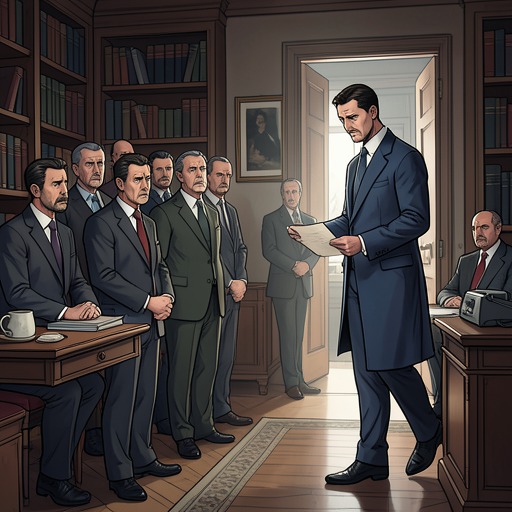
Dobchinsky is identified in the play’s character list as a country squire. The text supplies little private background beyond that social designation, and gives no separate account of his family, property, or history. Instead, it introduces him through action: he and Bobchinsky enter together, out of breath, announcing an extraordinary occurrence. Their breathless arrival turns the inn into the focus of the officials’ attention and brings their observations directly before the Governor.
The pair’s entrance establishes a shared function, but their speech soon differentiates them. Bobchinsky takes the lead in telling the story, while Dobchinsky is both a participant in the investigation and the subject of Bobchinsky’s teasing interruptions. Their partnership is therefore not presented as a pair of equally composed informants. It is a comic collaboration in which the urgency of what they have seen competes with Bobchinsky’s impatience to control how it is told.
The Inn and the Mistaken Inspector
At the inn, Dobchinsky and Bobchinsky notice a young man in citizen’s clothes who has been staying there. In Bobchinsky’s account, Dobchinsky beckons to Vlas, the innkeeper, and quietly asks who the stranger is. The answer gives the pair a sequence of concrete details: the young man is an official named Ivan Aleksandrovich Khlestakov, traveling from Saint Petersburg toward the Saratov government. He has stayed for a second week without leaving the house and has taken his meals on account without paying.
Those details do not establish that the traveler is an inspector. Instead, the pair interpret his official origin, prolonged stay, and unpaid bills as signs that something unusual is happening. Bobchinsky reports that the information makes a sudden impression on him, and he brings it to the Governor. When Dobchinsky confirms that the traveler does not pay and does not leave, the Governor reacts with terror and asks whether it can really be the inspector. Dobchinsky’s part in the discovery is thus practical rather than analytical: he helps obtain the innkeeper’s account, while the officials’ fear supplies the meaning they attach to it.
The episode shows how quickly partial information becomes institutional certainty. The stranger’s actual circumstances are ordinary enough to be described as a traveler’s delay and debt; in the town’s atmosphere of impending inspection, the same facts seem incriminating and official. Dobchinsky helps set that chain in motion, but the mistaken conclusion belongs to the group that receives and amplifies the report. His importance lies in the transfer of information, not in any claim that he knows the traveler’s true identity.
Partnership with Bobchinsky
Dobchinsky’s closest documented association is with Bobchinsky, who accompanies him to the inn and reports their joint inquiry. Bobchinsky says that Dobchinsky beckoned to Vlas and asked the decisive question about the young man. The account makes Dobchinsky an active partner in gathering evidence, even though Bobchinsky controls the narration of their discovery.
That imbalance is itself part of the scene’s comedy. As Bobchinsky recounts the conversation, he tells Dobchinsky not to interrupt and insists that Dobchinsky cannot tell the story properly, mocking his lisp and the whistle of his single tooth. The rebuke does not erase Dobchinsky’s contribution: the inquiry attributed to him is essential to their report. Instead, it makes their partnership vivid through a small conflict over who gets to speak. Dobchinsky helps produce the news; Bobchinsky claims authority over its performance.
Messenger and Petitioner
After the Governor decides to deal with the supposed inspector, he gives Dobchinsky a private errand. The Governor instructs him to run as fast as he can and carry two notes, one to Zemlianika at the hospital and one to his wife. This moment extends Dobchinsky’s function beyond the original discovery: the Governor relies on him to carry confidential instructions while the town responds to the threat of inspection. The evidence establishes the order, though not whether or how quickly Dobchinsky completes it.
Dobchinsky also approaches Khlestakov directly and asks permission to make a favor request concerning a delicate matter. The scene identifies the request’s cautious phrasing, but the available text does not disclose its substance or outcome. It therefore presents another instance of Dobchinsky acting on the opportunity created by Khlestakov’s assumed status without establishing precisely what Dobchinsky hopes to obtain. His appeal places him among the people who turn toward the supposed inspector, but does not warrant treating the favor as a specific payment or claim.
Narrative Role
Dobchinsky’s appearances connect three stages of the play’s comic machinery: observation at the inn, alarm in the Governor’s circle, and action directed toward the supposed inspector. He helps supply the report on which others act, is then entrusted with messages by the Governor, and finally addresses Khlestakov with a request of his own. These roles make him a useful intermediary in a town where information and authority are unevenly distributed.
At the same time, the play limits what can be said about his personal development. The evidence gives him a social identity, a partnership, an investigative action, a messenger’s assignment, and a petition; it does not give him an independent account of the town’s abuses, a sustained motive, or a resolution to his request. His characterization is consequently defined less by a private arc than by his place in the escalating confusion. The investigation he shares with Bobchinsky furnishes the officials with a stranger to fear, and the mistaken belief that follows turns an innkeeper’s ordinary report into the first link in the town’s wider performance of anxious deference.